


Te got left out and you still don’t know it
At the end of February 2026 something unusual happened in the financial markets.
A small research firm published an essay on Substack. It was not an official report, nor a document from the IMF, nor a formal economic forecast. It was a speculative text written as if we were in the year 2028 looking back to understand how a crisis caused by artificial intelligence had begun.
In less than 48 hours, the Nasdaq fell more than 1%. Several technology companies lost between 4% and 10% of their market value. And the White House had to publicly deny the scenario.
That text is now known as the Citrini Report.
A report that should not have moved markets
Citrini Research is not a major financial institution. It does not carry the weight of the Federal Reserve or Goldman Sachs. It is a small macroeconomic analysis firm that publishes reflections and scenarios about the global economy.
That is why what happened is so striking.
A simple narrative essay —not a mathematical model nor an academic study— was enough to shake financial markets for several days.
The reason was not the authority of the firm.
It was the idea the report proposed.
An uncomfortable idea: that artificial intelligence could be creating an economic crisis that we still cannot clearly see.

The central idea: a silent spiral
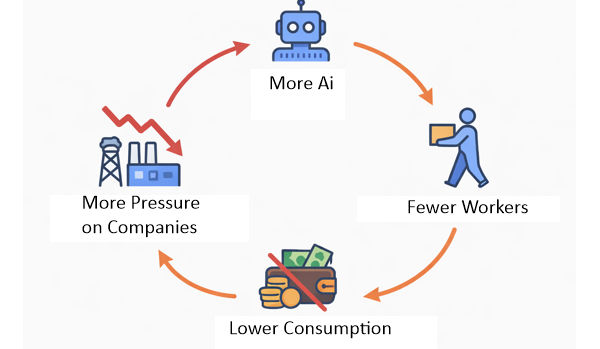
The report describes a very simple mechanism.
When artificial intelligence improves, companies can produce more with fewer people. That increases efficiency and profits in the short term.
But it also reduces the need for workers.
As more workers are pushed out of the labor market, consumption begins to fall. And when consumption falls, companies look for ways to reduce their costs even further in order to survive.
The fastest way to do that is to invest in more automation.
Which restarts the cycle.
More AI → fewer workers → less consumption → more pressure on companies → more AI.
A spiral that feeds itself.
Why this time could be different
In economic history, every technological revolution has destroyed jobs but also created new ones.
Mechanization eliminated manual labor jobs but created factories. Industrial automation reduced workers on assembly lines but generated technicians, engineers, and operators.
There was always a new step to climb.
The problem raised by the Citrini report is that this time that step might already be occupied by the machine itself.
Artificial intelligence does not only automate repetitive tasks. It is also beginning to perform cognitive tasks: programming, writing, analyzing data, designing products.
In other words, tasks that until now belonged to office work.
For the first time, a technology can directly compete with the type of work that for decades was considered safe.

The most disturbing concept in the report
One of the most provocative ideas in the document is the concept of “phantom GDP.”
The argument is simple.
An economy can continue growing statistically while social reality deteriorates.
If machines produce more and more goods and services, GDP rises. But if the income generated by that production becomes concentrated in a few technology companies, money stops circulating among households.
Macroeconomic figures say everything is fine.
But consumption begins to weaken because fewer and fewer people have sufficient income.
In other words: the economy appears to grow, but prosperity disappears.
The sequence proposed by Citrini
The report describes a possible timeline.
First, companies adopt AI tools to improve productivity. This increases margins and investors celebrate the efficiency.
Stock prices rise.
Layoffs are interpreted as a positive signal for the market.
But while profits grow, the labor market begins to slowly deteriorate.
The effects are not immediately visible because economic indicators take time to react.
When they finally appear in the data, the financial system is already deeply exposed.
In the scenario imagined by Citrini, this tension eventually generates a sharp correction in markets and a significant rise in unemployment.
Science fiction or warning?
Many economists have criticized the report.
The White House described it as a piece of speculative fiction. Some analysts pointed out that the pace of technological adoption is usually slower than what these scenarios assume.
It is also true that replacing workers with AI systems is not just a technical decision. It involves legal, organizational, and cultural changes that can take years.
But the debate is not really about the accuracy of the scenario.
It is about the direction of the trend.
Artificial intelligence is already transforming intellectual work. And it is doing so faster than many economic institutions can measure.
The question the report leaves
The Citrini Report talks about financial markets, technology companies, and major investors.
But the question it raises is far more personal.
If artificial intelligence can perform more and more cognitive tasks, what happens to the millions of workers whose value depended precisely on those tasks?
Designers. Analysts. Programmers. Writers. Translators. Knowledge workers.
It does not mean all of those jobs will disappear.
But it does mean that the balance of the labor market could change much faster than most people expect.
The real warning
Maybe the Citrini report is wrong about its timeline. Maybe the scenario will never happen exactly as described.
But there is a reason the text caused such a reaction.
Not because it predicts the future with precision.
But because it points to something that is already beginning to happen.
Artificial intelligence is not only changing tools. It is changing the relationship between work, productivity, and economic value.
And when that relationship changes, the rules of the game change as well.
The question is not whether artificial intelligence will transform your industry.
The question is whether you will realize it before it does.








 We turn your ideas into reality, creating unique digital experiences. With more than 15 years of knowledge and experience, we design and develop custom websites. We build brands and help them achieve success. We offer a complete service, from design and content creation to social media integration and administration.


