


In the digital age, where notifications, emails, and social media compete for every second of our attention, maintaining focus has become a Herculean task. Have you ever spent an hour "working" only to realize you made almost no progress on your main task? It's not a lack of willpower; it's a lack of a system.
To combat distraction and mental exhaustion (burnout), we don't need a complex technological tool, but a simple, biologically friendly framework. This is where the Pomodoro Technique comes in, a time management method that is extremely easy to implement and astonishingly effective for students, developers, designers, or anyone looking to improve productivity without feeling stressed.
The beauty of the Pomodoro lies in its simplicity. It is based on a fundamental truth about the human brain: our capacity for deep concentration is limited, and we need regular breaks to replenish energy and consolidate learning.

What It Is and Why the Pomodoro Technique Works
The Pomodoro Technique was created by Italian software consultant and entrepreneur Francesco Cirillo in the late 1980s. The name comes from the kitchen timer he used at the time, which was shaped like a tomato (pomodoro in Italian).
The central idea is simple: work is structured into short, intense blocks, interspersed with brief breaks. This not only makes it easier for the brain to maintain concentration, but also creates a sense of controlled urgency that fights procrastination. When you know you only have 25 minutes to work without interruption, your brain automatically focuses.
The 5 Fundamental Steps of the Pomodoro
Implementing the method is surprisingly easy and requires only a timer and the commitment to stick to the cycle. Here are the key steps:
- Planning: Choose the specific task you are going to work on. If the task is large (like "Develop the new web module"), break it down into smaller, specific subtasks (like "Write the HTML code for the contact form").
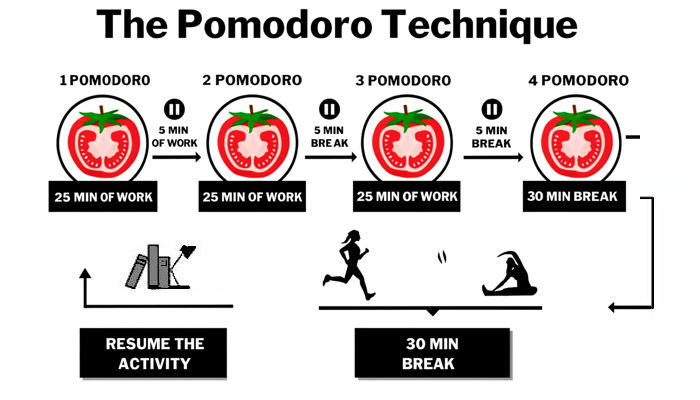
- Setup: Set your timer for exactly 25 minutes. This 25-minute block is one "Pomodoro."
- Deep Focus: Work intensely and without interruption on the chosen task. Close social media tabs, silence notifications, and concentrate exclusively on the goal.
- Short Break: When the timer rings, stop immediately. Take a 5-minute break. Get up, stretch, drink water, or just look out the window. The goal is to take your mind off work!
- Long Break (Reset): After completing four Pomodoros (four cycles of 25 minutes of work and 5 minutes of rest), take a longer break of 20 to 30 minutes. This break is crucial for preventing burnout and allowing your brain to consolidate what it has learned.

Why Bio-Psychology Loves the Pomodoro
The effectiveness of this technique goes beyond a simple organizational trick; it is supported by how our brain works:
1. Combats Decision Fatigue
The brain expends energy every time it has to switch tasks or decide what to focus on (this is known as the "context switching cost"). By planning the day into rigid 25-minute blocks, you minimize decision fatigue. You no longer have to think what to do, just do it.
2. Activates Reverse Parkinson's Law
Parkinson's Law states that "work expands to fill the time available for its completion." The Pomodoro applies the law in reverse: by imposing a 25-minute restriction, you force the task to shrink to fit that time. This eliminates excessive perfectionism and encourages action.
3. The Zeigarnik Effect (The Incomplete Task Bait)
Psychologist Bluma Zeigarnik discovered that we remember interrupted tasks better than completed ones. By forcing yourself to stop after 25 minutes, your mind keeps an "open loop" with the task. Instead of dreading returning, your brain feels a natural urgency to close that loop, making resuming work much easier.
How to Use Pomodoro to Overcome Procrastination
For the web developer or creative facing an overwhelming task, the Pomodoro is a superior anti-procrastination tool. The key is to reduce the barrier to entry.
If the idea of starting to code a complete module overwhelms you, the Pomodoro asks for something much smaller: "Just concentrate for 25 minutes." This short commitment is psychologically much easier to accept, and once the timer starts running, the inertia of the work pulls you in.
Managing Internal and External Interruptions
The strictest rule of the Pomodoro is: if you are interrupted (or interrupt yourself), the Pomodoro restarts. This forces you to be the guardian of your time.
- External Interruptions (Calls, People): If you are called or a colleague speaks to you, use the "Promise and Agenda Strategy": immediately jot down the interruption on a sheet (agenda) and tell the person: "I'm in a focus block right now, I'll call/find you in 30 minutes." Then, restart your timer if necessary.
- Internal Interruptions (Ideas, Social Media): If you suddenly remember an email you need to send or a brilliant idea for another project, immediately write it down on an "Ideas/To-Do" list and return to work. The idea is saved, and you don't have to spend mental energy recalling it.
Integrating Pomodoro into the Neobox Workflow
For a team or a freelance professional, the Pomodoro can be integrated as follows:
1. For Weekly Planning (Time Boxing)
At the beginning of the week, don't just make a list of tasks, but assign how many Pomodoros each one requires. A 4-hour task = 8 Pomodoros. This gives you a very realistic view of what you can achieve. If a task requires more than 4 Pomodoros, break it down.
2. For Meetings and Collaboration
Use the 25-minute structure for meetings. A focused 25-minute meeting eliminates rambling and forces quick decisions. This injects a sense of purpose and efficiency into the team culture.
3. Preventing Burnout
The mandatory 5-minute breaks are the anti-burnout key. These small breaks prevent your mental energy reserve from being completely depleted. The 20-30 minute long break after four cycles forces you to recharge, ensuring that the work is sustainable in the long term.
The Pomodoro Technique is a reminder that productivity is not about working longer, but about working smarter and respecting your brain's biological rhythm. It's a small analog tool (a timer) that enforces much-needed digital discipline in our hyper-connected world. Adopt it and you will see how that simple 25-minute restriction unleashes a power of focus you didn't know you had.









 We turn your ideas into reality, creating unique digital experiences. With more than 15 years of knowledge and experience, we design and develop custom websites. We build brands and help them achieve success. We offer a complete service, from design and content creation to social media integration and administration.


