Time Management has historically been based on a simple and often erroneous concept: that we can maintain a constant level of focus during the eight hours of a workday. We try to force concentration from 9:00 AM to 5:00 PM, and when we get exhausted, we feel like we have failed.
Science proves otherwise: your brain does not operate with the precision of a digital clock; it works with waves. Time Management 3.0 is the evolution that takes neuroscience as its starting point. If the Pomodoro (25 minutes) was the first step towards working in blocks, Management 3.0 is the intelligent personalization of those blocks, synchronizing your schedule with your internal neuronal rhythms.
In this Estudio Neobox article, we will explore how to integrate our biological cycles with intelligent algorithms to achieve deep focus without falling into burnout. The goal is simple: to work less time in the resistance zone and dedicate just the right time to the high-performance zone.
The Biological Secret: Ultradian Rhythms
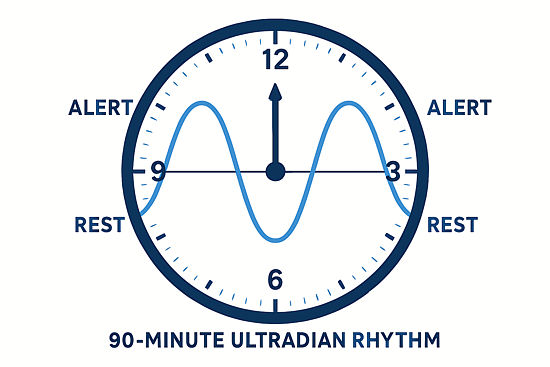
We all know the Circadian Rhythm (the 24-hour cycle that tells us when to sleep and wake up). However, our body operates with shorter cycles, called Ultradian Rhythms. Originally discovered in the 1950s, these cycles govern cognitive and physical performance throughout the day.
- Ideal Duration: Ultradian Rhythms operate in cycles of 90 to 120 minutes.
- The Cycle: During the first 90 minutes, your body and mind advance toward a peak of alertness and focus. After that time, the nervous system demands a natural break of 20 to 30 minutes to "clear the mental cache" and replenish glucose.
When we ignore this biological need and force ourselves to continue working after the 90-minute peak, we enter a period of resistance. Work becomes slow, errors increase, and quality plummets. This resistance is the true cause of fatigue at the end of the day.
The Leap from Pomodoro (25 min) to Ultradian (90 min)
The Pomodoro is excellent for overcoming procrastination, but neuroscience suggests that for deep cognitive work (such as code development, strategy, or design), 25 minutes is too short. The brain needs more time to enter a state of total flow.
- The New Block: Management 3.0 prioritizes blocks of 60 to 90 minutes for maximum priority work, followed by a mandatory break of 20 to 30 minutes.
- The Break is Crucial: The break is not a reward; it is part of the productivity process. It is the time the brain uses to consolidate learning and regenerate neuronal energy.
The challenge is that, although 90 minutes is the average, your biological rhythm is unique. Your peak alertness might be at 75 minutes or 100 minutes. This is where Intelligent Algorithms make the difference.
The Intelligent Algorithm: Personalizing Your Energy
Time Management 3.0 tools (like Clockwise or Reclaim.AI, based on the list we analyzed in our previous article) use AI to go beyond simple task organization; they organize your energy.
1. Identifying Performance Peaks (Biological Time Boxing)
AI learns your work patterns by cross-referencing data from your calendar, your location, and, in some cases, even subtle metrics of your behavior. When are you fastest at answering emails? When do you reserve the most time for complex tasks?
The algorithm helps you identify your Maximum Alert Peak (the ideal time for strategic work) and your Energy Valley (the ideal time for light tasks or breaks).
2. Automatic Creation of Focus Blocks (Focus Time)
AI doesn't just tell you when to focus; it automatically blocks it in your calendar, protecting that time from meetings. If a colleague tries to schedule a meeting during your Focus Time, the AI automatically suggests the next available slot outside your high-performance window. This is called AI-assisted "Time Boxing."
3. The Art of the "Mirror Task"
An intelligent management tool can analyze the complexity of your pending tasks and automatically assign the most demanding tasks (deep work) to your alertness peaks and the repetitive tasks (shallow work) to your energy valleys. It is Time Boxing so advanced that it tells you not only when to work, but what to work on.
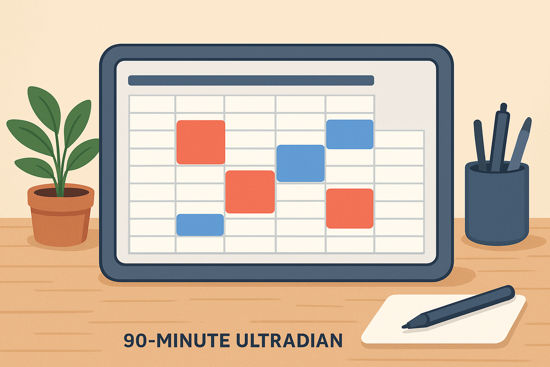
Designing Your Workday with Bio-Synchronization
To apply Time Management 3.0, you don't need to wait for the AI to tell you exactly what to do. You can start today:
Step 1: Identify Your Chronotype
Are you a "Lark" (maximum energy in the morning), an "Owl" (maximum energy at night), or a "Hummingbird" (more stable energy)? Most productivity systems are designed for Larks. If you are an Owl, you must intentionally rearrange your day so that your most important tasks are performed after lunch or in the evening.
Step 2: Take Active Breaks (Clear the Cache)
During the 20-30 minute break after your 90-minute block, avoid consuming new information. Do not check social media; do not watch videos. The break should be a physical or mentally passive activity: stretching, meditating, looking out the window, or having coffee away from the desk. This allows the brain to consolidate the information from the previous block and recover.
Step 3: Protect the Context
AI is excellent at protecting your time from external interruptions (meetings), but you must protect it from internal interruptions. Use the rules we discussed with the Pomodoro Technique: if an idea comes to you, write it down in a safe place (the interruption agenda) and immediately return to the 90-minute focus. Every context switch costs neuronal energy.
Time Management 3.0 is not about enslaving yourself to a new methodology, but about respecting your biology. By synchronizing the rigor of block planning with the flexibility of your ultradian rhythm, you will not only increase your productivity but also experience a drastic reduction in stress. You will be working with the flow of your brain, not fighting against it.
Sustainable productivity lies in bio-synchronization. The work of the future is short, intense, and perfectly aligned with the natural rhythms of your brain. AI is only the translator between your biology and your calendar.