You have surely heard/read about these two concepts, which, although not the same, are close and desirable relatives, if they are transformed into skills.
Both approaches foster creativity and innovation; lateral thinking focuses on finding non-obvious solutions, while disruptive thinking seeks to completely transform and revolutionize a sector or market.
Lateral thinking helps you find solutions outside conventional paths, exploring non-traditional perspectives to solve problems creatively. On the other hand, disruptive thinking involves questioning and breaking established models and norms to create radical and innovative changes in an industry or field, challenging the status quo. You will surely feel closer to one than the other. But...
The problem is not whether you feel closer to one than the other; the real trick of modern innovation is to learn to use both as interchangeable tools. If you want your company not only to survive but to redefine its niche, you need both the scalpel of the lateral and the dynamite of the disruptive.
Next, we will explore the nature of each in depth and, most importantly, how they complement each other so that you can apply them to your Neobox team.
The Nature of the Twins: Key Differences
For a beginner in management or technology, the difference between the two can be blurry. Here is the analogy that clarifies it:
Lateral Thinking |
Disruptive Thinking |
| Goal: Solve an existing problem. | Goal: Create a new problem (for the competition). |
| Methodology: Move sideways (laterality), seeking a different perspective. | Methodology: Move up or down, eliminating or transforming the existing structure. |
| Result: Creative solutions and process improvements. | Result: New business models, paradigm shift in the sector. |
| Classic Example: A luggage company that, instead of putting wheels, adds a motor (creative improvement). | Classic Example: Uber, which did not improve the taxi service, but eliminated the need for a license, radio center, and taximeter, creating a totally new model. |
Lateral Thinking is the genius who says: "We have to get out of this box, how do we do it?" Disruptive Thinking is the genius who says: "Let's forget the box and build a circle where everyone thought only a box could be built."
Laterality in Action: Creative Everyday Solutions
Lateral thinking, popularized by Edward de Bono, is a skill that everyone can develop and apply every day. It is based on the art of questioning assumptions.
- Practical Example in Technology: A hosting company has a recurring problem: customers abandon the purchase at the last step because payment methods are slow or confusing.
- Conventional Solution (Vertical): Improve the speed of the payment server or add another gateway.
- Lateral Solution: Instead of improving the gateway, add a "Pay Later (30-Day Invoice)" button for new customers. The friction of immediate payment is eliminated, assuming a small risk to ensure a much higher conversion. It is a solution that was not obvious.
Methods to stimulate Lateral Thinking in your team:
- The Random Word: When the team is stuck on a problem, you introduce a completely random word (e.g., "giraffe") and ask the team to force a connection between the word and the problem they are trying to solve. This forces the mind to step off the logical track.
- Problem Inversion: Instead of asking, "How do we sell more software?", ask, "How do we make people NOT buy our software?". By solving the inverse problem, you often discover crucial weak points and lateral solutions.
Disruption in Action: Breaking the Mold
Disruptive thinking does not seek a 10% improvement; it seeks a 1000% improvement or, rather, a game change. It is based on identifying an underserved market segment or an unnecessary cost and attacking it.
- Classic Example: Apple and the iPod/iPhone. Apple did not create the first digital music player; that already existed. But Steve Jobs' disruptive thinking was: "The problem is not capacity, it is the interface and the distribution model." By creating the iTunes Store and a simple interface, he eliminated the CD model and the need for massive hard drives, making music consumption totally new. The disruption was not just the product, but the ecosystem.
Keys to foster Disruptive Thinking in your company:
- The "Why Not" Question: Instead of following the roadmap, force the team to ask: "Why couldn't we offer our web development service for free and make money on post-sales support?". Questions that challenge the current business model are the seed of disruption.
- Identify the Non-Consumer: Who is not currently using your product or service and why? Disruptive thinking often begins by creating something simpler and more accessible for people who previously could not afford the current solution. (Example: Canva vs. Photoshop).
Can these two types of thinking coexist in a work team?
Absolutely! These two approaches, lateral thinking and disruptive thinking, can coexist perfectly in a work team and, in fact, their combination can be very powerful for fostering creativity, innovation, and growth. It may be outside the traditional canons. But an open-minded manager will choose them without hesitation, leave them alone for a while, and find surprising results upon their return.
Lateral thinking, finding unique and creative solutions from unconventional perspectives, can be very useful for solving everyday problems, improving processes, and generating new ideas in different areas of your company.
While disruptive thinking, radically changing the game and revolutionizing the market, will boost innovation in products or services, breaking with established norms and opening new business opportunities. Blessed niches!
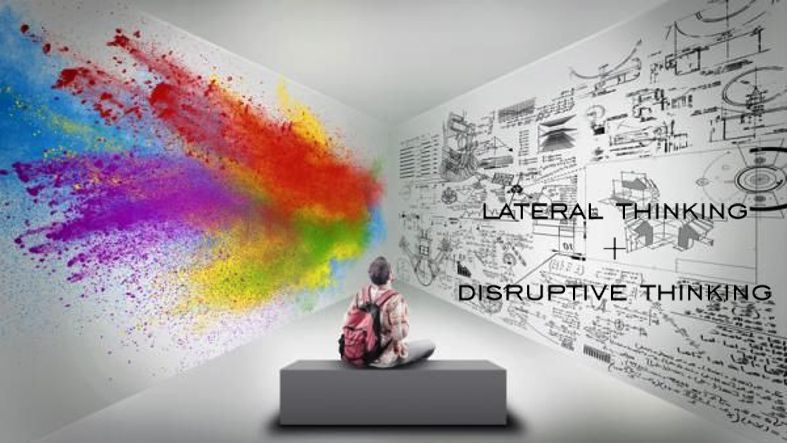
Now, imagine the combination!
When these two approaches are combined, a more dynamic and progressive business culture can be achieved, where creativity and experimentation are valued. By encouraging employees to think laterally and propose disruptive ideas, the company can remain competitive, adapt quickly to market changes, and find new ways to stand out.
The synergy is the key. Lateral Thinking provides the creative "bricks" and unexpected solutions for small challenges. Disruptive Thinking provides the "architectural vision" to build something completely new with those bricks.
A High-Performance Team Uses Both:
- Lateral Phase (Exploration): The team sits down and generates 50 absurd ideas to improve the onboarding process for new clients, without judgment.
- Disruptive Phase (Selection and Execution): The leader selects one or two of those laterally creative ideas and takes them to the extreme, asking: "Could we make this so radically simple that others take two years to copy us?".
This combination creates a culture of dual innovation: they can solve today's problems with creativity (Lateral) while building the future of the company (Disruptive).
Thus, not only are lateral thinking and disruptive thinking complementary and can coexist to boost innovation and growth in a company, but they will also encourage the rest of the team to give every topic a 'twist' and use both approaches to achieve surprising results.
Transform the "What" into the "How"
Both lateral and disruptive thinking are, at their core, disciplines. They are not innate talents but skills that are trained.
For any professional in technology or business, the secret lies in practicing laterality with small problems (How do I get out of this situation with the resources I have?) and disruption with big questions (Could my company exist in a completely different way?).
By actively fostering non-linear creativity, you are giving your team the superpower not only to solve the present but to design the future of your market. It is the most valuable skill a leader can cultivate in the digital age.